

Preparation, education, and follow-up
A patient can miss preparation steps, after-care instructions, warning signs, appointments, or the actions expected before the next clinical interaction.
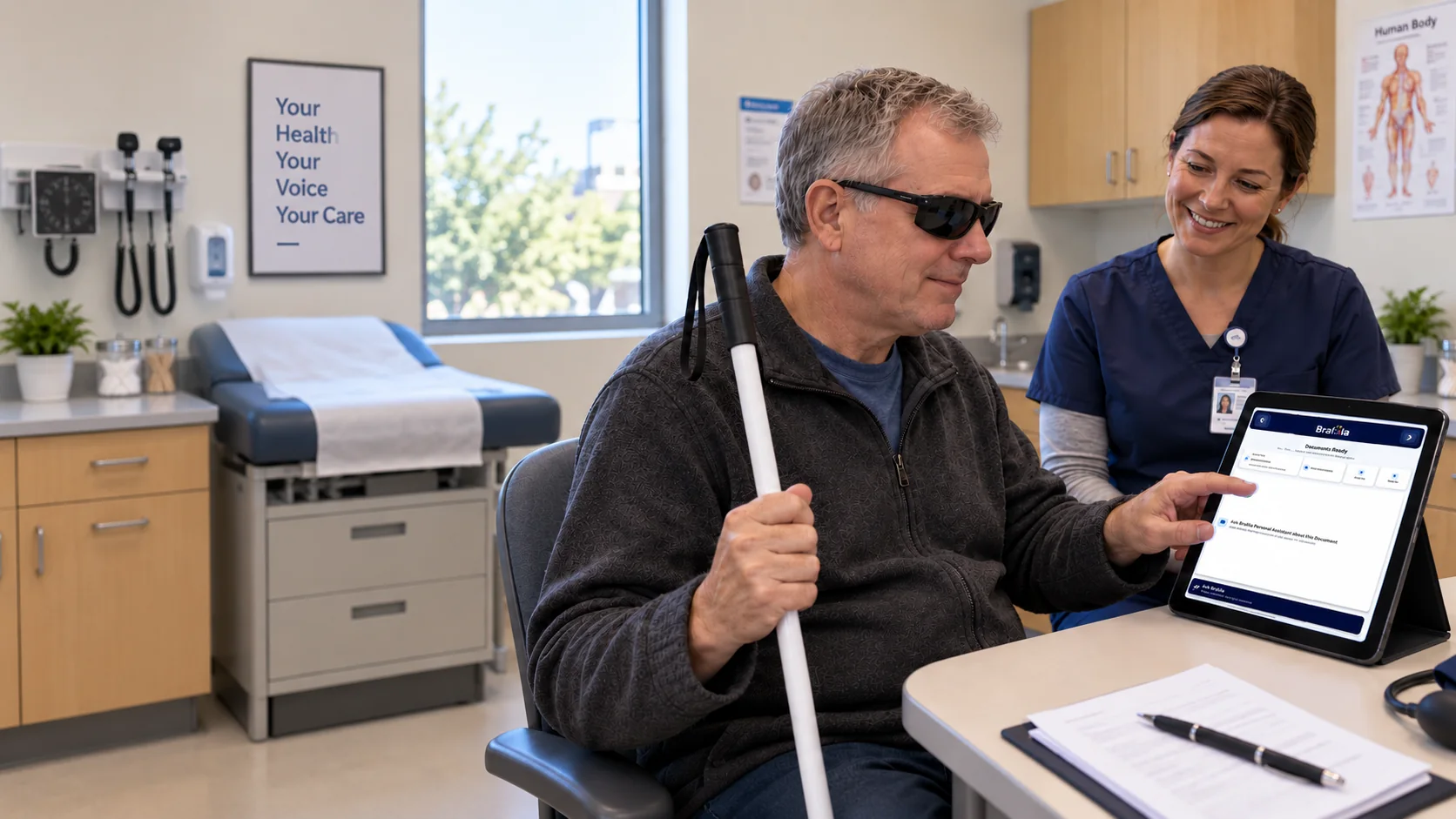
A blind patient uses a tablet with Braillia while a healthcare professional supports the consultation.
Healthcare communication accessibility
Braillia helps healthcare organizations make patient websites, documents, forms, education, billing, and follow-up information accessible, so people can receive, navigate, and act on it independently while existing EHR, portal, and communications systems remain in place.
The access consequence
How do I prepare for my procedure? What do my medication instructions say? What do I need to do when I get home?
For patients with disabilities, answers to these questions can be locked inside documents they can’t independently access. That can mean waiting for someone to read private health information aloud or leaving an appointment without usable instructions for what comes next.
Patients deserve an independent way to access their information, ask questions, and revisit important instructions, so they can take an informed, active role in their own care.
A patient can miss preparation steps, after-care instructions, warning signs, appointments, or the actions expected before the next clinical interaction.
An inaccessible amount, coverage explanation, form, deadline, or service notice can create financial confusion and delayed action.
A person can struggle to find services, prepare for a visit, navigate public information, or use facility-controlled PDFs and instructions.
Accessible healthcare information exchange
Braillia helps healthcare organizations make patient-facing information usable after it leaves a clinical or administrative system, so a person can receive, navigate, understand, and return to it without relying on someone else to read it aloud.
Prepare
Structure patient education, preparation instructions, discharge information, consent materials, administrative forms, billing communication, and follow-up notices so the facts, relationships, and required actions remain available nonvisually.
Deliver
Deliver accessible information through the channels the organization authorizes, including an existing portal, direct delivery, email, a secure link, QR pickup and SMS text delivery, or a connected workflow.
Understand
A patient can use voice-guided access to navigate their healthcare information, listen to important details, and return to anything they need explained. With Ask Braillia, they can ask questions by voice and get answers grounded in their document—helping them understand what matters and what to do next.
Ask Braillia | Personal AI healthcare assistant
Ask Braillia gives patients with disabilities a voice-guided way to explore and understand the healthcare information their care team has provided through an approved workflow. Patients can ask questions in their own words, listen to answers and summaries, and return to important details whenever they need to.
From appointment forms and medication instructions to discharge guidance and follow-up steps, Ask Braillia helps patients find and understand the information they need to participate in their care with greater independence.
“What do my instructions say about preparing for this procedure?”
“When is my follow-up appointment?”
“Can you summarize my discharge instructions?”
Each implementation defines the approved source, authorized users, delivery method, access controls, retention, and clinical-review boundaries. Privacy and security obligations depend on the organization, systems, and workflow.
The information chain
Accessibility can fail at several points, but a credible implementation begins where the responsible organization or its provider can actually change the information path.
EHR, revenue-cycle, patient education, scheduling, communications, and facility data
Portal, engagement, billing, forms, document, website, and communications platforms
Patient portal, app, website, email, PDF, print, kiosk, facility, and care-team channels
A person who must independently understand the information and prepare or act
Prepare, consent, follow instructions, pay, respond, return, or ask an informed question
Enter where change is possible
Braillia can work directly with the organization where it owns the information, or through the provider and integrator where the platform controls production and delivery.
Facility-controlled entry
Public websites and non-EHR PDFs, patient education, administrative documents, accommodation communication, facility-created notices, on-site information, and separately contracted billing communication can provide a focused starting point when the health system controls the boundary.
Primary control
Braillia's role
Assess or transform the authorized information, create appropriate accessible outputs, and preserve the instructions, facts, and actions the patient needs within the approved facility workflow.
Provider-sponsored entry
When the EHR, patient portal, patient-engagement, revenue-cycle, billing, forms, or healthcare communications platform generates and presents the information, a sponsored provider or implementation partnership is the credible path to production.
Primary control
Braillia's role
Define a source-specific transformation, embedded support, or output integration around the approved healthcare workflow without replacing the clinical or financial system of record.
The credible first workflow
Choose patient information with a clear owner, required action, and controllable source boundary. For EHR- or portal-generated communication, include the responsible provider or implementation sponsor from the beginning.
Review a Patient CommunicationA practical answer
Healthcare organizations can make patient information accessible by preserving the instructions, dates, amounts, choices, warning signs, and next actions a person needs, then delivering that information through an accessible format or experience the patient can navigate independently. The workflow must also identify who owns the content, which system controls it, who reviews it, and how privacy and security requirements apply.
Braillia can begin with facility-controlled websites, PDFs, patient education, administrative documents, billing communication, and on-site information. When an EHR, patient portal, revenue-cycle system, or engagement platform controls the source or experience, the scalable path is a source-specific implementation sponsored with that provider or systems partner. Braillia works around the system of record; it doesn't replace it.
Practical healthcare answers
Start with the patient actions that can't be lost: medications, timing, warning signs, follow-up appointments, restrictions, contact information, and when to seek help. Preserve those relationships in a structured accessible output, keep the clinical review owner in the workflow, and deliver the approved information through the patient channel or a separately authorized access path.
Yes. Facility-controlled documents can enter a defined transformation and delivery workflow outside the EHR. For information generated or presented by the EHR or patient portal, Braillia scopes an implementation with the platform owner or sponsor so the source system remains authoritative while an approved accessible output or support layer enters the patient experience.
Use an authorized workflow that preserves the intended recipient, limits access to the approved information, protects the content in transit and at rest as required, and applies the organization's authentication, retention, review, and support boundaries. Accessibility and privacy are evaluated together; the complete healthcare organization and workflow determine which legal and security requirements apply.
The approval team
Which patient information creates the greatest confusion, dependence on staff, or delayed action?
Who owns the content, review, timing, and patient action for this workflow?
Which website, PDF, education, notice, or billing communication can the organization control?
Which data, authorization, retention, integration, and clinical boundaries apply?
Where can accessible output or support enter the patient workflow?
Evidence for the decision
Give accessibility, operations, IT, security, and procurement the evidence they need before the first implementation decision.
Review current Braillia intake, processing, output, and remediation states.
Open Evidence PackageSee how a source-specific implementation can fit around an existing patient, billing, portal, or communications system.
Review IntegrationPrepare privacy, access, retention, data-handling, and implementation questions before controlled discovery.
Review SecurityDefine the communication, owners, patient outcome, evidence, and scale decision before an implementation begins.
Open Scope TemplatePrimary references
These public sources establish the surrounding accessibility, patient-understanding, and health-information safeguards. A healthcare organization's complete legal and security obligations depend on its role, systems, data, and workflow.
Buyer questions
Government and business teams can begin with one accountable workstream, then expand the operating model only when another accessibility responsibility requires it.
Braillia works around existing systems. A healthcare organization can begin with information it controls directly or sponsor a source-specific implementation with the provider that controls the patient experience.
Begin with a facility-controlled website, non-EHR PDF, patient-education or administrative document, on-site information workflow, or separately controlled billing communication. Include the technology provider from the start when the EHR or portal controls the source and experience.
No. Each implementation begins by confirming the source, workflow, privacy and security boundary, clinical or administrative reviewers, required outputs, and responsible provider. Braillia then scopes the integration needed for that environment.
Bring Braillia one patient education, appointment, administrative, billing, discharge, follow-up, or facility-controlled communication. We'll define who controls it, what the person must accomplish, what evidence matters, and where Braillia can enter.