

Person
A customer must understand and respond before service is affected.
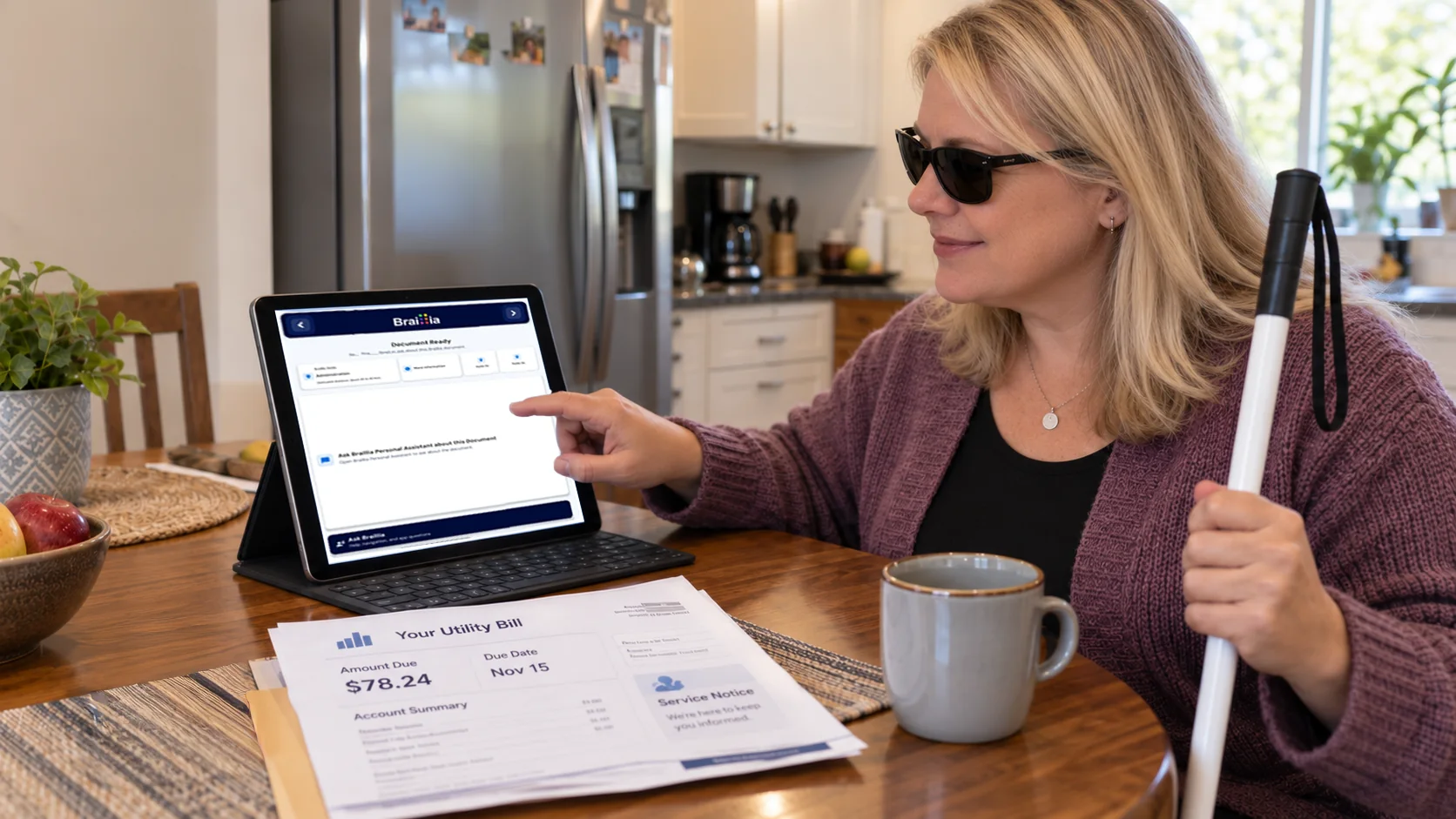
A blind utility customer uses Braillia on a tablet to review a utility bill at home.
Utility customer accessibility
Braillia helps municipal, cooperative, and regional utilities turn bills, shutoff notices, payment plans, assistance information, and outage communication into accessible information customers can understand and act on independently.
Person
A customer must understand and respond before service is affected.
Control
The organization owns the outcome; its platform or provider may control the technology.
First move
Choose one consequential workflow, identify its owner, and prove a usable path.
The access consequence
A bill or shutoff notice can be technically delivered and still leave a customer with a disability unable to find the amount due, deadline, assistance option, or action required. The customer loses time and control while contact-center, billing, accessibility, and regulatory teams absorb the failure.
Charges, usage, due dates, and payment options can lose their meaning when visual relationships don't survive nonvisual reading.
A missed deadline can interrupt electricity, water, heating, medical equipment, housing stability, and personal safety.
Customers need timely service status, safety instructions, restoration information, and assistance eligibility in a form they can use.
The information chain
Accessibility can fail at several points, but a credible implementation begins where the responsible organization or its provider can actually change the information path.
CIS, metering, service, assistance, and account data
Billing, document composition, print, and notice systems
Portal, email, print, payment, outage, and customer-service channels
A person who must understand the information independently
Pay, request assistance, prepare for shutoff, or respond to service conditions
Enter where change is possible
Braillia can work directly with the organization where it owns the information, or through the provider and integrator where the platform controls production and delivery.
Utility-controlled entry
Field-created notices, assistance information, payment-plan communication, service instructions, and selected billing documents can establish a first workflow without replacing the customer information system.
Primary control
Braillia's role
Assess the access break, transform the selected communication into appropriate accessible outputs, preserve review evidence, and add direct, QR, SMS, web, or mobile use when the workflow requires it.
Platform-controlled entry
When a CIS, document-composition provider, print-and-mail vendor, payment portal, or digital-service platform controls recurring output, the implementation must include that provider or the responsible systems integrator.
Primary control
Braillia's role
Define a source-specific integration that transforms approved data or generated documents into accessible formats and returns them to the utility's existing delivery workflow.
The credible first workflow
Choose a recurring, consequential communication with a clear owner and action. The first evaluation should prove whether a customer can receive it, navigate it, understand the important facts, and complete the required next step.
Review a Utility CommunicationThe approval team
Can customers understand and act without calling staff to read the notice?
Who controls the source, composition, production, and release path?
What user outcome and review evidence must the utility demonstrate?
What data, systems, access, retention, and integration boundaries apply?
Where can accessible output enter the recurring production workflow?
Evidence for the decision
Give accessibility, operations, IT, security, and procurement the evidence they need before the first implementation decision.
Review current Braillia intake, processing, output, and remediation states.
Open Evidence PackageSee how technical findings connect to user consequence, priority, repair, and validation.
Review MethodologyPrepare data-handling, access, retention, and implementation questions for the scoped workflow.
Review SecurityDefine the source, owners, outputs, evidence, and scale decision before implementation begins.
Open Scope TemplatePrepare a municipal or public-utility evaluation across accessibility, operations, IT, security, and procurement.
Open Capability BriefBuyer questions
Government and business teams can begin with one accountable workstream, then expand the operating model only when another accessibility responsibility requires it.
Braillia is designed to work around the system of record. A utility can begin with communication it controls directly or define an integration with the provider that generates recurring bills and notices.
Begin with one recurring bill, shutoff notice, payment-plan communication, assistance notice, or outage instruction with a named owner and a clear customer action.
Yes. Appropriate structured outputs can work independently with familiar systems and assistive technology. Braillia delivery and mobile guidance can be added when the utility needs organization-managed delivery or continued support.
Bring Braillia one bill, notice, payment, assistance, or outage communication. We'll define who controls it, what the person must accomplish, what evidence matters, and where Braillia can enter.