

Defense in depth
Braillia combines layered controls across public access, protected remediation, private processing, signed delivery, access control, retention, and auditability.
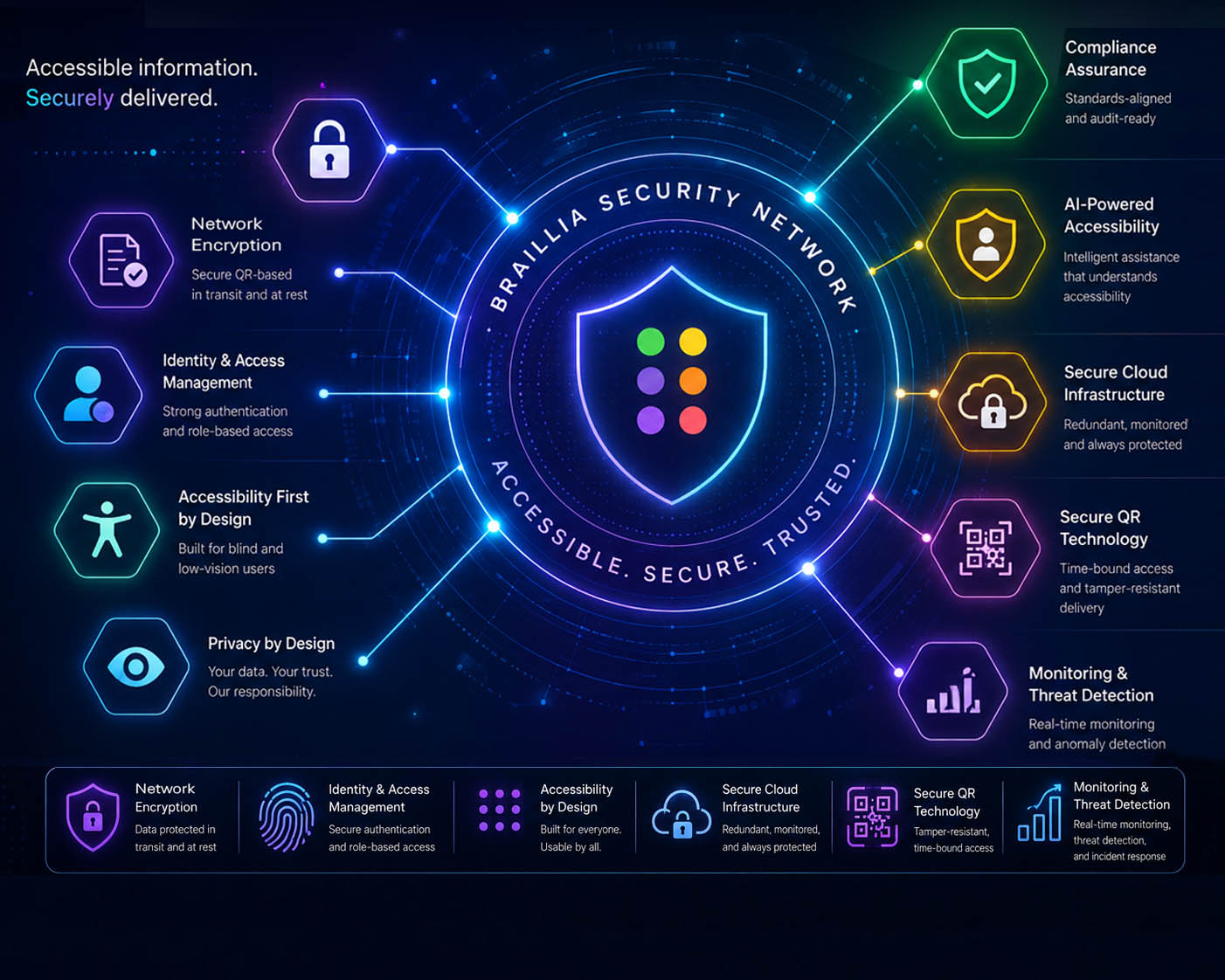
Braillia security network graphic showing layered controls for encryption, identity and access management, privacy, compliance assurance, AI accessibility, secure cloud infrastructure, direct delivery, QR setup, and monitoring.
Platform security
Braillia’s document accessibility platform is designed to help organizations remediate, process, deliver, and guide access to documents, notices, messages, and mobile experiences through secure workflows with governance, privacy, retention, and operational oversight built into the platform story.
Trust layers
Braillia's security network combines protected remediation, privacy-aware processing, identity controls, direct delivery, QR setup and pickup, monitoring, governance, and secure delivery for accessible information workflows.
Braillia combines layered controls across public access, protected remediation, private processing, signed delivery, access control, retention, and auditability.
Document accessibility work is treated as a controlled processing workflow, with attention to intake, readable content, generated artifacts, release paths, and cleanup.
Public traffic is limited to intended entry points while remediation, publishing, processing, storage, AI orchestration, and internal services stay behind private operational boundaries.
Mobile delivery, pickup, and background workflows use signed, expiring access patterns that reject forged or stale requests.
Braillia must process readable content to remediate, structure, and transform it into accessible experiences, so the trust model centers on protected processing, least privilege, retention, and audit trails.
Security model
Braillia is built for organizations handling important and often sensitive communication. Security, privacy, retention, access, and oversight are part of the remediation and delivery model because accessible information still has to be protected.
Platform trust controls
Security, privacy, and governance are part of document accessibility from the beginning. Braillia uses layered controls to protect remediation workflows, document delivery workflows, organization access, mobile delivery and pickup, assisted processing, and operational oversight.
The browser-based user and organization portals interact with defined public services, while remediation, processing, databases, queues, AI services, and worker paths remain inside private operational boundaries.
Document intake, readable content processing, generated accessible output, and release steps are framed as controlled workflows rather than ad hoc file handling.
Organization access is designed around authenticated users, account membership, administrative roles, and internal operator boundaries.
Direct delivery, QR setup and pickup, mobile retrieval, delivery actions, and background processing callbacks are designed to use signed, time-limited trust patterns rather than open document links. SMS delivery sends a document-access link to the person’s phone; opening it takes them to the Braillia Portal, where the organization’s recipient-access requirements apply.
Production configuration is designed around externalized secrets and managed secret references rather than plain values committed into application code.
Braillia’s production posture includes secure session handling, HTTPS-first delivery, browser protection headers, host controls, and request protection patterns.
Login lockout and API throttling patterns help protect authentication, API, and mobile endpoints from brute force attempts and noisy clients.
Remediation work, processing, pickup, temporary artifacts, and assisted access workflows are designed around lifecycle cleanup and data minimization principles.
Attachment intake is designed around controlled handling, malware safety checks, and release controls before files become available through remediation or delivery workflows.
Security review readiness
The public page establishes the security direction while protecting deploy-time specifics. Braillia can discuss detailed architecture, cloud configuration, sensitive data workflows, and customer policy alignment through the appropriate review process.
Security principles, control categories, access model, privacy posture, retention approach, and security review readiness.
Infrastructure diagrams, service names, internal URLs, source references, token formats, bucket paths, runbooks, and environment-specific configuration.
Braillia’s security model treats governance, data handling, GDPR-related considerations, retention-aware workflows, evidence, and platform controls as part of document accessibility and delivery. The core principle is simple: users need access to information, and organizations need that access delivered through responsible operational controls.
Buyer questions
Government and business teams can begin with one accountable workstream, then expand the operating model only when another accessibility responsibility requires it.
GDPR is a privacy and data protection framework. Braillia addresses GDPR-related concerns through security, data handling, access control, retention-aware workflows, and governance; accessibility conformance is evaluated through the applicable accessibility standards.
Document accessibility often involves readable content from healthcare, billing, benefits, legal, education, or account workflows. Braillia gives organizations protected workflows for remediation, processing, and accessible delivery.
Braillia provides a secure document accessibility and delivery workflow that fits into the organization's broader privacy, security, procurement, and compliance programs.
Public security content explains Braillia's security posture and control categories while protecting internal topology, service names, token details, source references, and environment-specific configuration. Authorized reviewers can evaluate deeper implementation details through the appropriate security process.
Braillia processes document content to transform it into accessible formats. The security model uses protected backend processing, TLS in transit, encryption at rest, short-lived access, least-privilege roles, retention controls, and audit trails. This differs from a strict end-to-end encryption model where only the final user can decrypt content.
Define the information involved, processing boundary, access pattern, retention needs, and required evidence before implementation decisions are made.