

Person
A rider must understand the time, place, eligibility decision, service change, or required action before travel is disrupted.
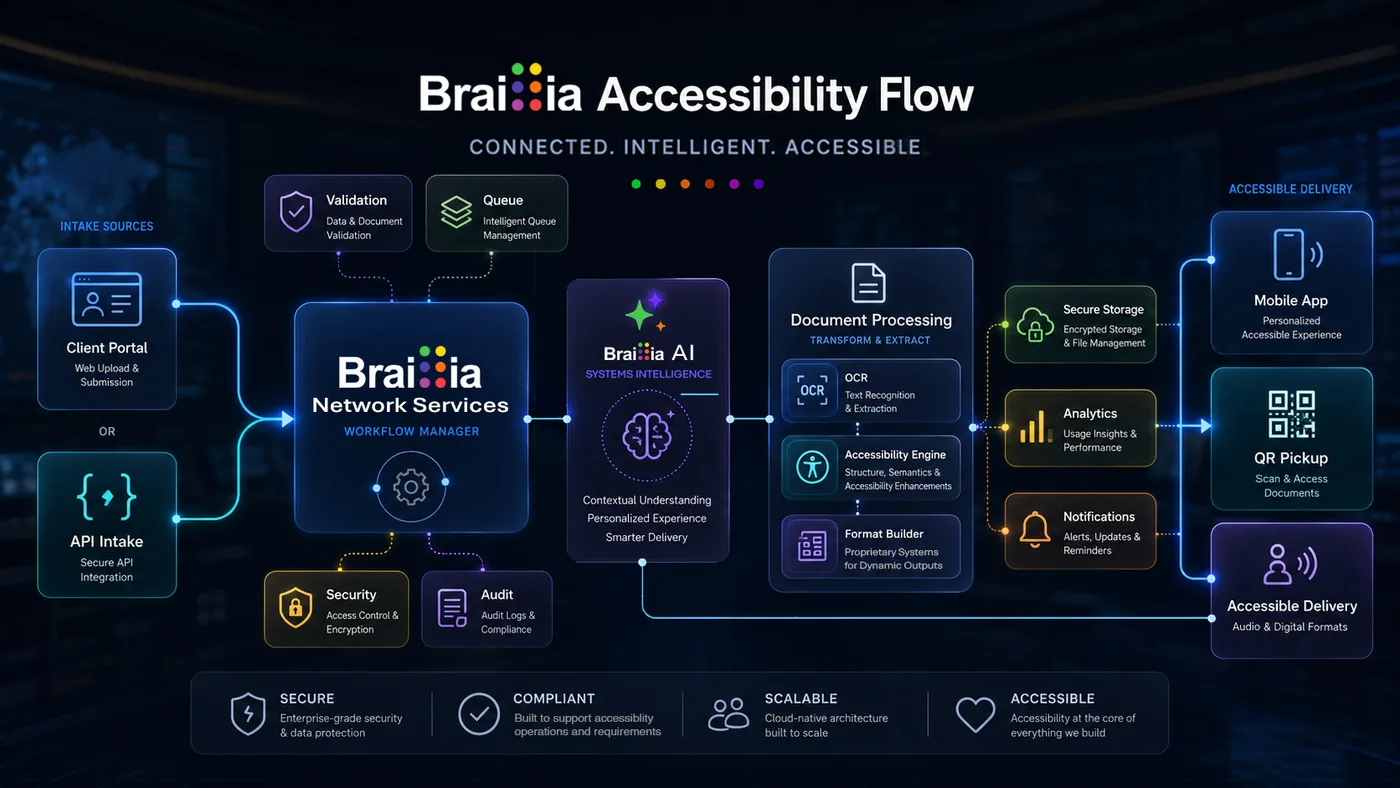
Braillia accessibility flow connecting approved source systems to document processing, accessible outputs, mobile access, and delivery experiences.
Transportation communication accessibility
Braillia helps transit agencies, mobility providers, rider-service teams, and transportation technology partners transform service notices, eligibility packets, paratransit communication, rider forms, schedules, and required-action information into structured, accessible experiences people can use while timing and mobility still matter.
Person
A rider must understand the time, place, eligibility decision, service change, or required action before travel is disrupted.
Control
The organization owns the outcome; its platform or provider may control the technology.
First move
Choose one consequential workflow, identify its owner, and prove a usable path.
The access consequence
A service change, paratransit decision, eligibility packet, reservation instruction, rider form, or facility notice can determine whether someone reaches work, care, school, or home. When the information isn't independently usable, the rider may miss a trip, lose time, or depend on staff to interpret the service.
A rider can miss a changed route, stop, time, boarding location, temporary instruction, or the alternative needed to complete the trip.
An inaccessible packet or decision can delay required evidence, an appeal, scheduling, or access to a mobility service.
A person can struggle to prepare, complete a form, find the right facility information, or understand what to do next.
The information chain
Accessibility can fail at several points, but a credible implementation begins where the responsible organization or its provider can actually change the information path.
Scheduling, fare, eligibility, paratransit, reservation, operations, and rider data
Rider-information, notification, forms, mapping, document, and mobility platforms
Website, app, email, PDF, print, call center, station, stop, kiosk, and facility channels
A person who must independently understand the service and complete the trip
Qualify, reserve, prepare, board, transfer, respond, or reach the destination
Enter where change is possible
Braillia can work directly with the organization where it owns the information, or through the provider and integrator where the platform controls production and delivery.
Agency-controlled entry
Locally created service notices, eligibility correspondence, paratransit packets, rider forms, accommodation communication, facility information, and supplemental instructions can establish a focused workflow without replacing the fare or scheduling platform.
Primary control
Braillia's role
Transform an authorized communication into appropriate accessible outputs, preserve the time, place, decision, and action that matter, and connect the result to an approved rider access path.
Platform-controlled entry
When scheduling, fare, reservation, eligibility, paratransit, notification, mapping, or rider-information technology controls the task, the platform provider or transportation integrator belongs in the implementation path.
Primary control
Braillia's role
Define a source-specific accessible-output, embedded-support, or transformation path around the approved transportation workflow without replacing the operating system.
The credible first workflow
Choose rider information with a clear agency owner, timing requirement, and user action. Include the responsible provider from the beginning when a scheduling, fare, eligibility, or rider-information platform controls the source and experience.
Review a Rider CommunicationThe approval team
Which rider information creates the greatest disruption, dependence on staff, or missed travel?
Who owns the decision, schedule, timing, content, and required rider action?
Which notice, packet, form, website, or facility information can the agency control?
Which systems, rider data, access, retention, and integration boundaries apply?
Where can accessible output or support enter the rider workflow?
Evidence for the decision
Give accessibility, operations, IT, security, and procurement the evidence they need before the first implementation decision.
Review current Braillia intake, processing, output, and remediation states.
Open Evidence PackageSee how a source-specific implementation can fit around an existing scheduling, fare, eligibility, or rider-information system.
Review IntegrationPrepare rider-data, access, retention, and implementation questions for a controlled transportation workflow.
Review SecurityGive accessibility, rider services, operations, IT, security, legal, and procurement one shared decision list.
Open ChecklistPrepare a public-transportation evaluation across accessibility, rider services, operations, IT, security, and procurement.
Open Capability BriefBuyer questions
Government and business teams can begin with one accountable workstream, then expand the operating model only when another accessibility responsibility requires it.
Braillia works around existing systems. An agency can begin with information it controls directly or sponsor a source-specific implementation with the provider that controls the rider experience.
Begin with one service-change notice, eligibility packet, paratransit communication, rider form, schedule, facility instruction, or deadline-bearing workflow with a named owner and measurable rider outcome.
No. The current public path focuses on accessible rider information, documents, websites, delivery, and approved system integrations. Any facility or location technology requires separate product readiness, site design, implementation scope, and validation.
Bring Braillia one service change, eligibility packet, paratransit notice, rider form, schedule, or facility communication. We'll define who controls it, what the person must accomplish, what evidence matters, and where Braillia can enter.